
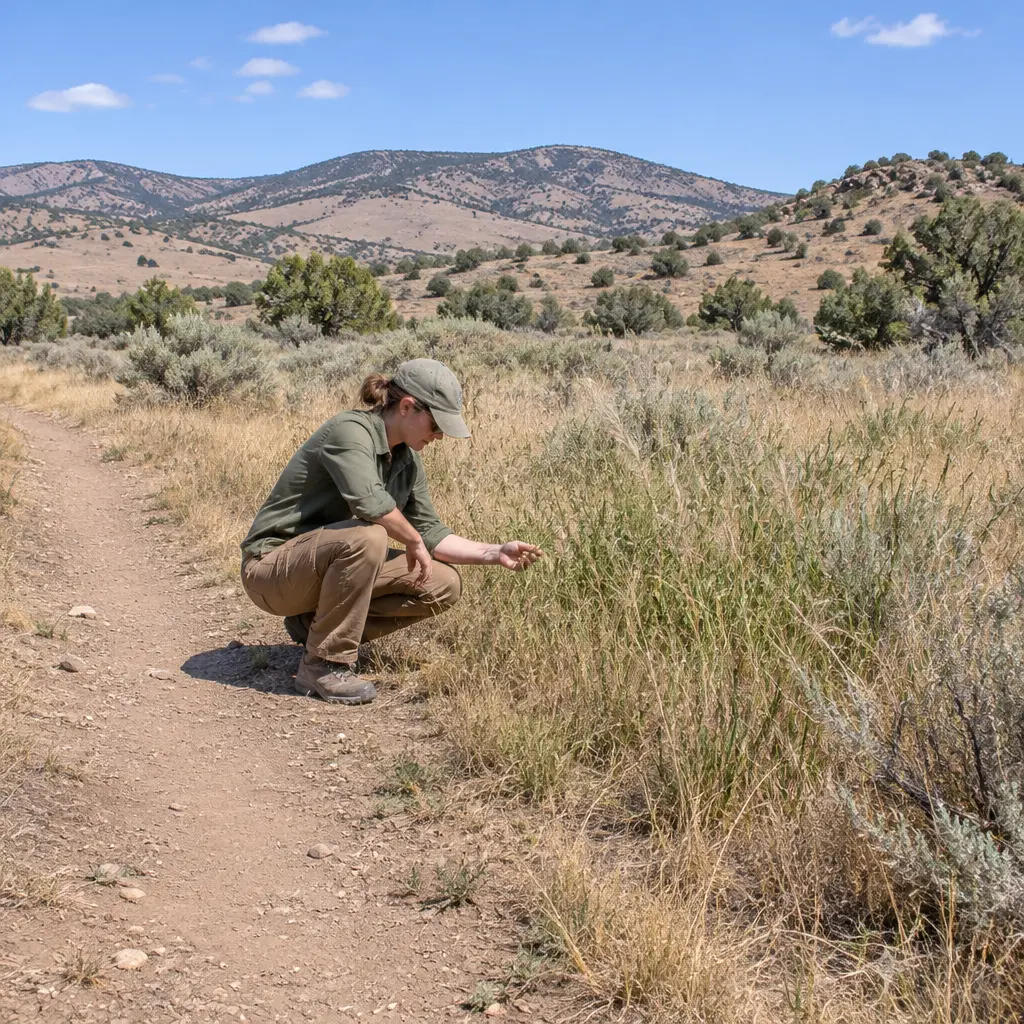
Wildland fire risk is rising in many places where invasive plants alter the amount, continuity, or seasonal dryness of vegetation. Invasive grasses and shrubs can create fine, fast-drying fuels that help fires spread, while wildfire can in turn expose ground and resources that favor further invasion. The scale of the danger depends on local climate, plant communities, and land management—not every invasive species increases fire risk, and not every fire is caused by invasion. Research in the western United States, including studies of cheatgrass and buffelgrass, documents important examples of this feedback. Understanding fuel changes, fire behavior, ecological impacts, and management options is increasingly urgent as agencies report larger and more costly fires in a warming climate.
How invasive plants change wildland fire risk
An invasive plant is a nonnative plant whose introduction causes, or is likely to cause, environmental or economic harm. The U.S. Department of Agriculture’s National Invasive Species Information Center uses this harm-based distinction: a plant is not considered invasive simply because it originated elsewhere. In fire-prone landscapes, the relevant attribute is how an invasive plant changes fuels—the live and dead vegetation that can ignite and carry fire.
Fuel characteristics include the quantity, moisture, arrangement, and continuity of vegetation. A dense carpet of dry grass can connect otherwise separated shrubs, increasing the chance that flames travel across a landscape. Invasive plants may also change the timing of fire by curing earlier or remaining dry longer than native vegetation. These effects vary by species and ecosystem; a local assessment is more reliable than assuming every nonnative plant makes a place more flammable.
The broader context is significant. The National Interagency Fire Center reported that the United States experienced 64,897 wildfires and about 8.9 million acres burned in 2024. Those totals reflect many drivers—including weather, drought, ignition, and land use—not invasive plants alone. They nevertheless show why understanding how vegetation influences fire spread matters for prevention, ecological restoration, and community preparedness.
Fuel continuity links invasive plants to fire behavior
Fire behavior describes how a fire spreads, burns, and releases energy under particular fuel and weather conditions. The U.S. Forest Service explains that fire behavior is shaped by interactions among fuels, weather, and topography. Invasion can alter one part of that system: vegetation that fills gaps between existing fuel patches may make fire spread more continuous, while a taller or denser plant community may change flame contact and intensity.
Fine fuels and rapid drying
Fine fuels are small plant materials, such as grasses, leaves, and thin twigs, that can dry and ignite relatively quickly. Invasive annual grasses can produce abundant fine fuel during a wet growing season and then cure into dry material as temperatures rise. That sequence can create a short-lived but highly connected fuel bed. Wind, low humidity, and prolonged heat can intensify the threat, so plant cover alone cannot predict whether a fire will start or spread.
Fuel continuity and the spread of fire
Fuel continuity is the degree to which burnable vegetation connects across space. Invasive grasses can occupy bare ground between shrubs or trees, allowing a surface fire to move through areas that previously had fewer links between fuel patches. In the Great Basin, the U.S. Geological Survey and other researchers have documented how the nonnative annual grass cheatgrass, or Bromus tectorum, can form nearly continuous fine fuels in some sagebrush ecosystems. The result is not inevitable in every invaded stand, but where fuel continuity increases, fire can become more frequent and harder to contain.
This fuel connection leads to the ecological consequences of repeated burning: fire may remove native plants, open space for reinvasion, and reinforce a cycle that favors fast-growing invaders.
Invasive grasses can reinforce fire cycles
A grass–fire feedback is a cycle in which invasive grass promotes fire, and fire creates conditions that help the grass spread or persist. It is most consequential where native plants are poorly adapted to frequent burning and where the invader can quickly recolonize disturbed ground. The cycle’s strength differs among regions and is influenced by drought, grazing, soil, ignition patterns, and the availability of native seeds.
Cheatgrass in the Great Basin
Cheatgrass is an annual grass that germinates early, grows rapidly, and often dries before many native plants. In parts of the Great Basin, its dense growth can increase fine-fuel continuity and shorten the interval between fires. The U.S. Geological Survey’s research on sagebrush ecosystems describes how this shift can reduce habitat for species associated with intact sagebrush, including greater sage-grouse. Repeated fire can make it difficult for slow-growing sagebrush to recover before the next burn, while cheatgrass can re-establish from seed.
Buffelgrass in the Sonoran Desert
Buffelgrass, Cenchrus ciliaris, is a perennial grass introduced for uses including forage and erosion control. In parts of Arizona and northern Mexico, it can grow in dense clumps that connect desert vegetation otherwise separated by open ground. The National Park Service identifies buffelgrass as a concern because it can carry fire through Sonoran Desert landscapes where many native plants are not adapted to frequent, widespread burning. This case illustrates how a plant introduced for a practical purpose can create ecological risks when it spreads beyond managed sites.
How fire creates opportunities for reinvasion
Fire can remove plant cover, expose soil, and reduce competition, creating opportunities for invasive species to establish. But post-fire invasion is not automatic: outcomes depend on surviving native plants, the soil seed bank, nearby seed sources, rainfall, and follow-up management. Where invasive grasses do recolonize quickly, their fine fuels can increase the likelihood of another burn. This possibility makes early detection and post-fire monitoring important parts of fire-risk planning.
Ecological and community consequences extend beyond flames
Fire risk associated with invasive plants is not limited to the immediate danger of a blaze. Changes in fire frequency can reshape habitat, reduce native plant recovery, affect wildlife, and increase smoke exposure. The consequences are uneven: communities near the wildland–urban interface may face direct threats to homes and infrastructure, while remote ecosystems may experience long-term losses in biodiversity and resilience.
Habitat, biodiversity, and recovery
Many native plants and animals depend on a particular fire regime—the typical frequency, intensity, season, and pattern of fire in an ecosystem. When invasive plants contribute to more frequent or more continuous burning, that regime can shift beyond the range some native species tolerate. In sagebrush country, for example, extensive loss of mature sagebrush can reduce habitat and food resources for wildlife. Restoration may require more than suppressing the invader: native plants must also be able to re-establish under local climate and soil conditions.
Smoke, infrastructure, and public safety
A vegetation-driven fire can threaten roads, power lines, homes, and public lands, while smoke can affect people far from the burn. The U.S. Environmental Protection Agency notes that wildfire smoke contains fine particulate matter, which can aggravate respiratory and cardiovascular conditions. Invasive plants are only one factor in this chain of risk, but their influence on fuel continuity can matter where communities and critical infrastructure meet fire-prone landscapes.
Management can reduce risk when it matches local conditions
Invasive-plant and fire management works best when agencies identify the species and fuel conditions driving risk, then combine prevention, targeted control, restoration, and monitoring. There is no universal treatment: mowing, grazing, prescribed fire, herbicides, or mechanical removal can be useful in some settings and ineffective or harmful in others. Treatment plans should account for the possibility that disturbance itself may help invasive plants spread.
Prevention and early detection
Preventing new infestations is often less costly than controlling an established one. Land managers can inspect high-risk areas, clean equipment and vehicles before moving between sites, use weed-free materials for restoration, and report unfamiliar plants to local invasive-species programs. Early detection is especially valuable along roads, trails, utility corridors, and disturbed ground, where seeds and plant fragments can be transported or establish readily.
Targeted fuel and vegetation treatments
Targeted treatments aim to reduce hazardous fuel while avoiding unnecessary damage to native vegetation. Depending on the site, managers may remove invasive plants mechanically, use carefully selected herbicides, or apply managed grazing. Prescribed fire is not automatically appropriate for invasive-grass control: burning can sometimes stimulate further invasion or leave a site vulnerable to reinvasion. The U.S. Forest Service and land-management agencies emphasize planning treatments around local ecology, weather, safety, and follow-up needs.
Native restoration and post-fire monitoring
Restoration seeks to re-establish native plant communities that can compete with invaders and support ecosystem functions. Projects may use locally appropriate seed mixes, protect recovering vegetation from damaging disturbance, and monitor both native recovery and invasive regrowth. Monitoring after fire or treatment helps managers determine whether fuel continuity has actually declined and whether the intervention has produced unintended effects. Adaptive management—adjusting actions in response to observed results—is essential because climate and vegetation conditions continue to change.
Conclusion: treating invasion as part of fire planning
Invasive plants can increase wildland fire risk when they add dry fine fuels, connect fuel patches, or help create a recurring grass–fire feedback. Cheatgrass in the Great Basin and buffelgrass in the Sonoran Desert show how these mechanisms can affect ecosystems with different climates and native vegetation. The resulting risks include altered fire behavior, habitat loss, smoke, and threats to communities, but outcomes remain site-specific and depend on weather, topography, ignition, and land management.
Land managers, landowners, and community members can help by preventing new introductions, reporting suspected infestations, supporting locally designed restoration, and including invasive-plant monitoring in fire plans. Further reading from the National Invasive Species Information Center, U.S. Geological Survey, National Park Service, and local fire and land-management agencies can help identify species and actions relevant to a particular region.
Sources: U.S. Department of Agriculture, National Invasive Species Information Center, What Is an Invasive Species?, https://www.invasivespeciesinfo.gov/what-are-invasive-species; National Interagency Fire Center, Federal Firefighting Costs (Suppression Only), https://www.nifc.gov/fire-information/statistics/suppression-costs; U.S. Forest Service, Fire Behavior, https://www.fs.usda.gov/managing-land/fire; U.S. Geological Survey, Cheatgrass and Wildfire, https://www.usgs.gov/centers/forest-and-rangeland-ecosystem-science-center/science/cheatgrass-and-wildfire; National Park Service, Buffelgrass, https://www.nps.gov/sagu/learn/nature/buffelgrass.htm; U.S. Environmental Protection Agency, Wildfire Smoke and Your Patients’ Health, https://www.epa.gov/wildfire-smoke-course/wildfire-smoke-and-your-patients-health