
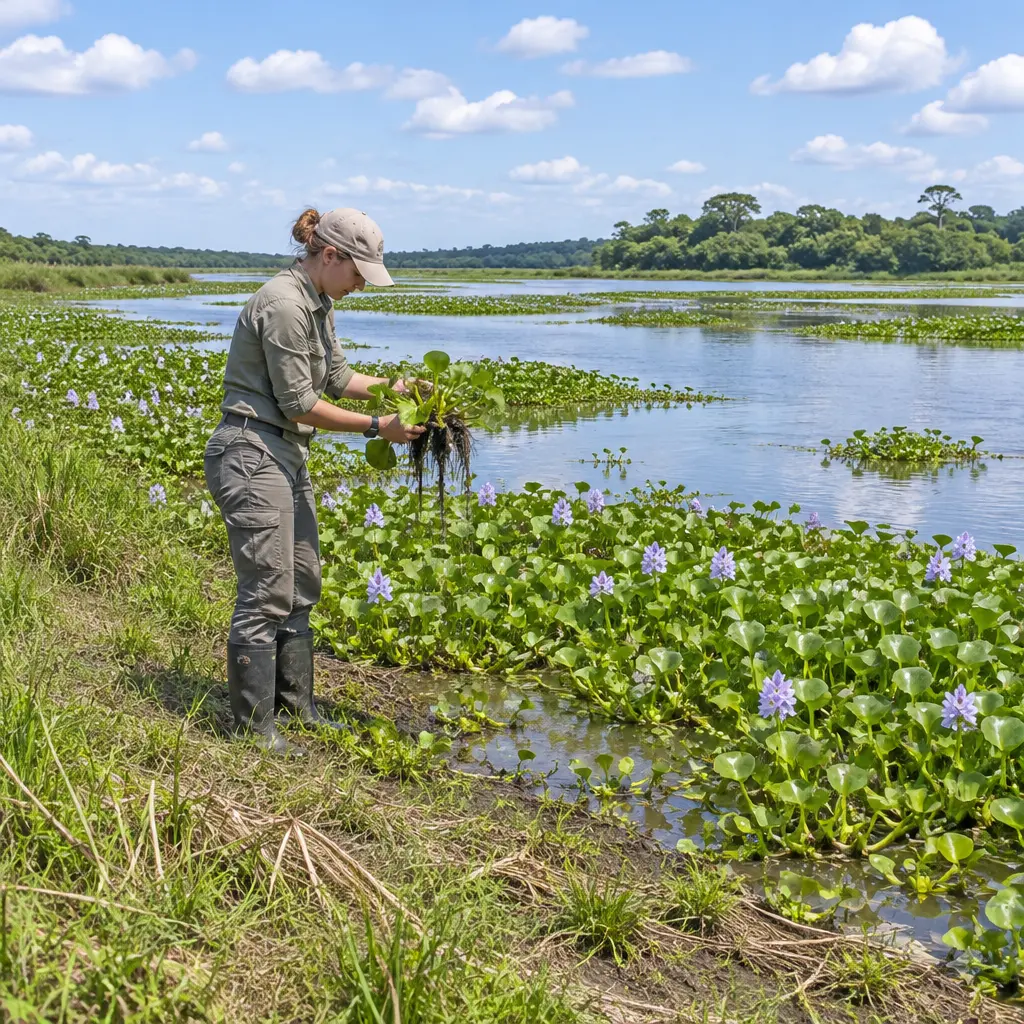
A plant can be harmless in one country and devastating in another because ecological impact depends not just on the species, but on where it grows. In its native range, a plant is embedded in long-standing relationships with herbivores, pathogens, competitors, and environmental limits; when people move it elsewhere, some of those constraints may be absent. The result can be rapid spread and serious damage—but only a minority of introduced plants become invasive. The contrast is illustrated by water hyacinth, a floating plant native to South America that has formed dense, costly infestations in waterways across Africa and Asia. Understanding this difference helps explain invasion risk, the role of climate and natural enemies, and why prevention and early detection matter.
Invasive plant impact depends on ecological context
An invasive plant is not simply a plant growing outside its native range. The U.S. National Invasive Species Information Center describes invasive species as non-native organisms whose introduction causes or is likely to cause economic or environmental harm, or harm to human health. A plant may be introduced and persist without becoming invasive; invasion involves establishment, spread, and consequential effects.
The same species can therefore have very different outcomes in different places. Its native range may contain insects that eat it, fungi that weaken it, competitors that limit its access to light and nutrients, and seasonal conditions that restrict growth. In a new range, a favorable climate combined with fewer effective enemies or less competition can allow the plant to become abundant. Human activities—including ornamental planting, agriculture, shipping, and contaminated soil or equipment—often provide the initial pathway.
The scale of the issue is substantial, though global figures describe invasive species collectively rather than plants alone. The Intergovernmental Science-Policy Platform on Biodiversity and Ecosystem Services (IPBES) reported in its 2023 assessment that more than 3,500 harmful invasive alien species have been documented worldwide and that invasive alien species played a role in 60% of recorded global animal and plant extinctions. IPBES also estimated annual global costs from biological invasions at more than US$423 billion in 2019. Those figures show why a plant’s changing ecological role is more than a botanical curiosity.
Ecological release explains why a plant’s impact changes
Ecological release is a useful explanation for why a species may become more abundant after moving beyond its native range. It describes a reduction in limiting pressures—such as herbivory, disease, competition, or environmental stress—that can allow a population to grow or use resources more freely. It is a hypothesis to investigate in each case, not a rule that every introduced plant will escape control.
Natural enemies can limit growth in the native range
Insects, grazing animals, plant pathogens, and parasites can reduce a plant’s survival, seed production, or competitive advantage. When an introduced plant arrives without the natural enemies that keep it in check at home, it may gain a relative advantage. Researchers call one proposed version of this pattern the enemy release hypothesis.
The hypothesis does not mean that introduced plants have no enemies. Native organisms may begin feeding on them, and the plants may acquire new diseases. Instead, the key question is whether the overall pressure in the new range is weaker or less effective than in the native range. Evidence varies among species and locations, so comparisons of herbivore damage, disease, growth, and reproduction are important.
Competition and predators shape local abundance
Plants compete for light, water, nutrients, and space. In a familiar ecosystem, a species may be kept in check by established vegetation, consumers, or disturbances such as flooding and fire. In a new ecosystem, it may encounter open ground, disturbed habitats, or few competitors able to suppress it. Some introduced plants also produce abundant seeds, spread through fragments, or grow quickly after disturbance—traits that can help them colonize available habitat.
These characteristics do not guarantee invasion. A plant must also encounter suitable conditions and successfully reproduce or spread. The distinction matters for management: removing a species from a garden is different from controlling a plant that has formed self-sustaining populations across wetlands, forests, or farmland.
Climate and habitat determine where a plant can thrive
Temperature, rainfall, growing-season length, soil, water chemistry, and disturbance all influence establishment. A species may be harmless in one country because winters are too cold, rainfall is too low, or its preferred habitat is scarce. In another region, similar temperatures and abundant suitable habitat may allow it to spread. Climate suitability is therefore one part of risk assessment, not a complete prediction: human introduction, reproduction, dispersal, and ecological interactions also matter.
Climate change can alter these conditions by shifting temperature and rainfall patterns, changing disturbance regimes, or opening new areas to species that previously could not persist. The direction and scale of any change depend on the plant and location. Risk assessments need to be revisited as environmental conditions and trade pathways change.
Introduced plants become invasive through pathways and impacts
Ecological release helps explain differences in abundance, while the invasion process explains how a plant moves from arrival to harmful spread. In invasion science, the stages are often described as introduction, establishment, spread, and impact. A plant can stop at any stage: many introduced species never form lasting wild populations, and many established non-native species do not cause significant harm.
Introduction pathways carry plants across borders
People move plants deliberately as ornamentals, food crops, forestry species, or erosion-control plants. They can also move unintentionally in nursery stock, seed mixtures, soil, packing materials, vehicles, and watercraft. Once established, seeds may disperse by wind, water, wildlife, or human activity. The Convention on Biological Diversity identifies pathways of introduction as a central focus for preventing biological invasions, because stopping a risky species before it establishes is often less costly than managing a widespread infestation.
Water hyacinth shows how a useful plant can become a costly invader
Water hyacinth (Pontederia crassipes, formerly Eichhornia crassipes) is a floating freshwater plant native to South America. It is also widely known as an ornamental, but outside its native range it can form dense mats that shade submerged plants, impede water flow, obstruct fishing and boat travel, and interfere with water infrastructure. The Food and Agriculture Organization has documented these kinds of impacts in affected waterways.
The contrast is not that the plant changes identity at a border. Rather, new waterways, local climate, nutrient conditions, and ecological controls can combine to favor its growth. Water hyacinth is often associated with nutrient-rich water, so wastewater and agricultural runoff can worsen some infestations. Its example also cautions against treating every case as simple enemy release: local water quality, spread by people and water, and the plant’s growth strategy all contribute.
Kudzu illustrates how planting decisions can outlast their purpose
Kudzu (Pueraria montana var. lobata) is native to East Asia and was introduced to the United States, where it was promoted for ornamental use, forage, and erosion control. In parts of the southeastern United States, its rapid growth allows it to cover trees and other vegetation, reducing access to light and changing habitats. The U.S. Department of Agriculture’s National Invasive Species Information Center documents its status and impacts in the country.
Kudzu’s history shows that a plant’s intended benefit does not predict its long-term ecological effect. A species planted to stabilize soil or provide forage can spread beyond managed areas, particularly when it thrives in local conditions and is difficult to remove once established. The same species may remain much less problematic where climate, land use, or management differs.
Prevention and early detection reduce invasion risk
Because ecological context makes outcomes difficult to infer from a plant’s behavior in its native range alone, risk management relies on prevention, assessment, monitoring, and control. A plant that is harmless today may still pose a risk in a region with suitable climate and habitat, while a species invasive elsewhere may fail to establish locally.
Risk assessment evaluates more than a plant’s reputation
A science-based assessment considers whether a plant can enter a region, survive its climate, reproduce, disperse, and cause ecological, economic, or health impacts. It also considers uncertainty and the consequences of a mistaken decision. The International Union for Conservation of Nature’s Environmental Impact Classification for Alien Taxa, known as EICAT, provides a standardized way to classify environmental impacts of alien taxa, including plants. Such tools help compare evidence, but they do not replace local knowledge or monitoring.
Early detection makes control more practical
Finding a new population while it is small can make eradication or containment more feasible than after widespread spread. Monitoring should focus on likely entry points and vulnerable habitats, including transport corridors, ports, disturbed land, wetlands, and areas near cultivation. Reporting suspected invasive plants to relevant local or national authorities can help verify identification and direct action.
Plant choices and hygiene help prevent spread
Gardeners, growers, land managers, and public agencies can reduce risk by choosing locally appropriate, non-invasive plants; checking regional restrictions before planting; and avoiding the dumping of garden waste into natural areas. Cleaning equipment, boats, and vehicles can also reduce the movement of seeds and plant fragments. Where a species is already established, control should be planned around its biology and the recovery of the affected habitat, because poorly timed removal can sometimes encourage regrowth or spread fragments.
Conclusion: A plant’s impact depends on place, pathways, and ecological relationships
The same plant can be relatively harmless in one country and devastating in another because ecological relationships and environmental conditions differ. Ecological release, competition, climate suitability, disturbance, and human introduction pathways can all help determine whether a non-native plant remains contained or becomes invasive. Water hyacinth and kudzu demonstrate how plants moved for ornamental, agricultural, or practical purposes can have unintended effects in new habitats.
The broader lesson is that a plant’s risk cannot be judged from its appearance or its behavior in only one place. Prevention, evidence-based risk assessment, early detection, and responsible planting decisions protect biodiversity, livelihoods, and infrastructure. Readers can help by checking local invasive-species guidance, choosing suitable alternatives, and reporting suspected new populations to the appropriate authorities.
Sources: Intergovernmental Science-Policy Platform on Biodiversity and Ecosystem Services, Summary for Policymakers of the Thematic Assessment Report on Invasive Alien Species and Their Control, 2023, https://www.ipbes.net/ias; U.S. National Invasive Species Information Center, What Are Invasive Species?, https://www.invasivespeciesinfo.gov/what-are-invasive-species; Convention on Biological Diversity, Pathways of Introduction of Invasive Alien Species, https://www.cbd.int/invasive/pathways.shtml; Food and Agriculture Organization of the United Nations, Water Hyacinth: A Plant with Many Uses and Many Problems, https://www.fao.org/4/af285e/af285e00.htm; U.S. National Invasive Species Information Center, Kudzu, https://www.invasivespeciesinfo.gov/terrestrial/plants/kudzu; International Union for Conservation of Nature, Environmental Impact Classification for Alien Taxa (EICAT), https://www.iucn.org/our-work/science-and-data/impact-classification-alien-taxa